C6: Complementing Existing Public Health Programs

Most existing public health programs and services can be expanded to ensure older adults’ needs are considered. This may include health screenings, which should include mental health status and potentially identification of signs of elder mistreatment.
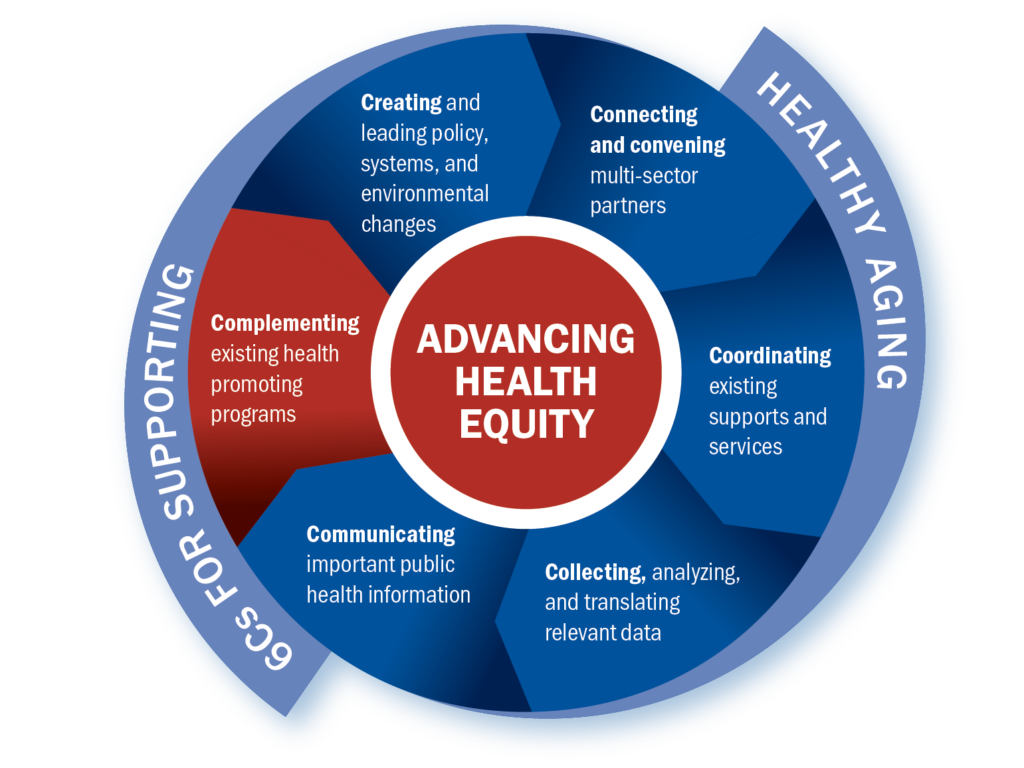
Example of C6: Building on existing programs for older adults can provide unique and effective strategies for addressing and preventing elder mistreatment. In Maine, the Department of Health and Human Services, the Elder Abuse Institute of Maine, Legal Services for the Elderly, the Office of the Attorney General, and the John T. Gorman Foundation collaborated to form the Elder Justice Coordinating Partnership. This group developed an Elder Justice Roadmap to guide Maine’s efforts in responding to and preventing elder abuse. A key component of this initiative is Elder Service Connections, which enables Adult Protective Services to refer older adults to an Elder Advocate through the Elder Abuse Institute of Maine.
Alignment with the 10 Essential Public Health Services: The public health sector can enhance equitable access to services by ensuring that population health approaches support the whole person across the life course, including preventive services. This might include behavioral and mental health services designed to mitigate the risks of elder mistreatment or self-neglect, as well as removing barriers to caring for victims of elder mistreatment.
Strategies
Examples/Resources
Expand mental health screenings to include identification of elder mistreatment.
Work with existing healthy aging coalition partners to provide education on the risk and protective factors of elder mistreatment; invite Adult Protective Services partners these coalitions.
Include screening for EM during home wellness visits.
Expand funding for existing older adult services in local public health departments.
Create and fund caregiving coalitions that unite caregiving leaders across states in a shared effort to strengthen support systems for family caregivers nationwide. The network cultivates and elevates state leaders who champion caregiver needs, fosters peer-to-peer learning on caregiving policy issues, and elevates family caregiving concerns on both state and national policy agendas.
Emphasize a life course approach to preventative services that includes elder mistreatment prevention through risk factor reduction.

The AFPHS 6Cs Training and Implementation Guide was developed by Trust for America’s Health with funding from The John A. Hartford Foundation and in partnership with the Education Development Center and the National Alliance for Caregiving.