C2: Connecting and Convening Multi-Sector Partners

The public health sector is well known for facilitating effective partnerships to address public health issues. Using this skill to enhance and build new connections and partnerships to prevent elder mistreatment can be an effective tool to identify new partners and build or tap into existing coalitions and networks that could help to leverage the development and adoption of elder mistreatment prevention strategies.
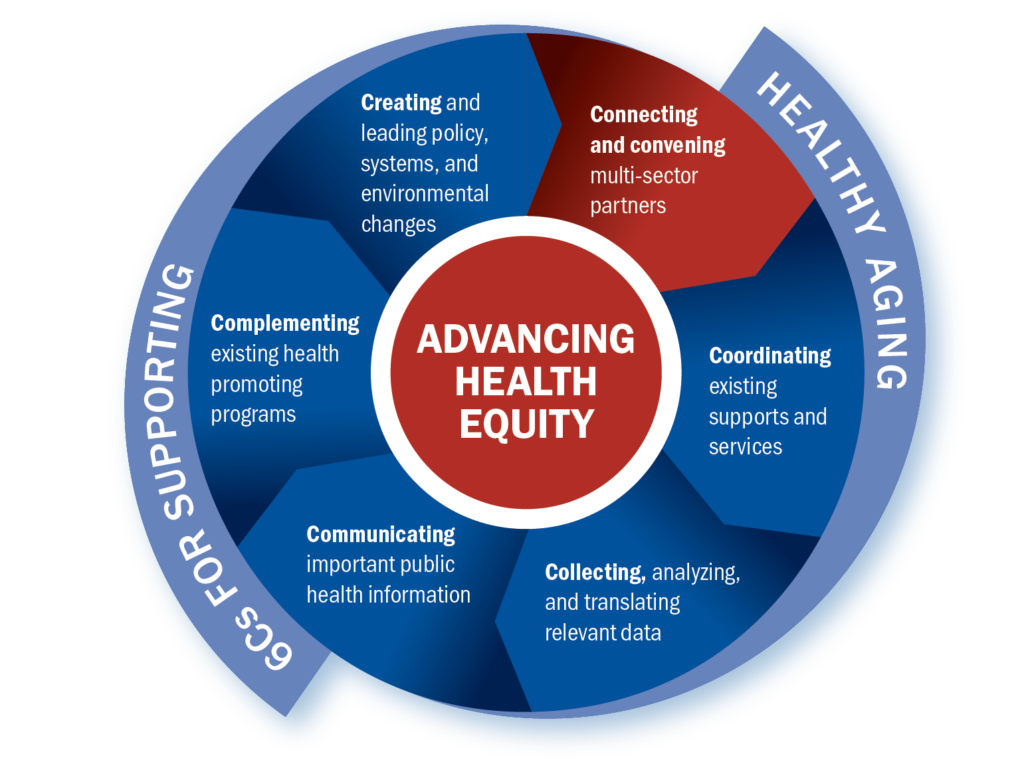
Example of C2: The Summit County Health Department (SCHD) in Ohio has served as the convener for the elder mistreatment project for many years. SCHD works with partners from their adult protective services agency, law enforcement, mental health providers, and others to identify victims of elder mistreatment, provide education and coaching or caregivers, share relevant resources, and manage referrals to appropriate agencies.
Alignment with the 10 Essential Public Health Services: Strengthening, supporting, and mobilizing communities and partnerships to improve health should include collaboration to prevent elder mistreatment, and support victims, families and perpetrators once mistreatment has occurred.
Strategies
Examples/Resources
Identify opportunities to embed elder mistreatment prevention in the work of age-friendly or healthy aging coalitions, movements, and conversations. For example, multi-sector plans for aging (MPAs) provide an opportunity to engage across sectors to embed EM prevention goals and strategies into new or existing work. MPAs are state-led, cross-agency, multi-year plans developed through a process that convenes a broad range of public and private partners dedicated to improving coordination among programs and services for older adults.
Implement programs to facilitate data sharing, training, and collaborative action planning among healthcare, social services, law enforcement, and legal teams.
- RISE Collaborative (Responsive Interdisciplinary Solutions for Elder Abuse)
Develop or engage with a multi-disciplinary team to prevent elder mistreatment and support victims and families. These teams often include screening and referral processes to ensure a streamlined approach within a jurisdiction. Partners to consider for including are adult protective services, aging services personnel, physicians, law enforcement, mental health practitioners, and victim-witness advocates.
- Abuse Intervention Model
- Department of Justice’s MDT Technical Assistance Center
- USC Center for Elder Justice MDT Resources
Engage community health workers (CHWs) who can provide connections between older adults and their families and formal support systems.
Work with community partners to develop and deliver community education and outreach on EM awareness, prevention, and protection.
Develop a specialized team, such as a multi-disciplinary team (MDT) to address severe mental health issues in individuals who do not meet traditional criteria for emergency intervention, with the goal of including a psychiatrist who can assess situations and issue a pink slip when necessary.
Identify novel partners for prevention activities, including libraries, hospitals, clinics, veterinarians, caregiver respite programs, mental and behavioral practitioners, emergency response personnel, and others.
- The American Library Association Elder Justice Task Force
- American Library Association: Libraries Respond: Services to Older Adults
- Urban Libraries Council Innovative Elder Abuse Prevention at Baltimore County Public Library
- Identifying Elder Abuse in the Emergency Department: Toward a Multidisciplinary Based Approach
Work with caregiver support programs and organizations to identify opportunities for education and training for caregivers.
- BRI Care Consultation (Benjamin Rose Institute) Comprehensive Older Adult Caregiving Supports program
Facilitate reciprocal referrals, connecting clients to appropriate services so that if a case doesn’t meet Adult Protective Services criteria, the individual can be referred to other community organizations for support.

The AFPHS 6Cs Training and Implementation Guide was developed by Trust for America’s Health with funding from The John A. Hartford Foundation and in partnership with the Education Development Center and the National Alliance for Caregiving.